Wednesday, 23 September 2015

Wow I'm a 2nd year student!


This photo can mean only one thing! My first train commute back to uni for my 2nd and final year!

I feel excited and nervous about the year ahead and the reality of how close I am to applying for jobs and preparing for life as a newly qualified OT is beginning to hit me! I have a feeling that this year is going to go even faster than the last!

We have started the week by beginning our new module in which we will be studying specialist areas of practice for OT's and there is a 30 minute assessed Viva in 6 weeks time! I have never done a viva assessment before but I feel this will allow me to develop my verbal communication skills/knowledge and prepare for interview environments! The topics we will cover during the module sound really interesting and I am looking forward to learning new things and also synthesising knowledge I have experienced of specialist areas from placement.

I have received my practice placement 3 allocation and this time I am with a community mental health team! I'm very excited about this as it is an area of practice that I am interested in yet have no experience of. This does make me slightly nervous however, because this placement is a step up to level 6 and a lot more is expected of me within an area I do not know a lot about! I will now contact my placement area and begin my much needed preparation!

I have also been assigned some 'buddies' through the new buddy system at uni where we as 2nd years have the opportunity to help and support 1st year students. I am looking forward to this opportunity. I think back to how I was feeling this time last year when everything felt so new and I didn't know what to expect. I would've quite liked to have a buddy. I remember feeling lost and anxious at the critical language of masters level study and the overwhelming un-certanty of what was expected of us at this level. I look back now a year on and I smile, I can't believe I'm here and that I made it through without failing a single thing. I really feel that OT is where I am meant to be and I'm proud of the journey I have been on that has got me here so far. Here's to another roller coaster ride of a year, but this time with a years experience under my belt.

I will post soon about my progress on beginning 2nd year, my new modules and dare I say dissertation? ....


Friday, 11 September 2015

Summer

Summer Holidays 


A break over the past few weeks has been much needed after the intense first year of the MSc! It has been important for me to switch off from uni and to engage in occupations that I do not have chance to whilst studying during term time.

On reflection from my first year I have thought of some tips to share with those who may be beginning the MSc in September:


  • Keep a diary! Managing your time is hugely important on an intense course like this one. Plan for classes and lectures in good time, begin your assignments early and most importantly, make some time for yourself!
  • Do plenty of reading! It took me a while to gain an understanding of academic literature from coming from a different degree background. But as I have read more and understood the language in which critical research articles are written, I feel my critical reading and writing skills have really improved!
  • Be prepared to work in groups and teams and allow room for flexibility in your routine for this.
  • Try not to panic, we have all been there it's perfectly normal to feel panicked and anxious (because you will at some stage) take a deep breath. The course intensity is a shock to your system but it will be ok!
  • If you are completely new to research (like I was) make a glossary and familiarise yourself with research terminology before your research lectures... trust me, I wish I had done this! 
  • Seek help and support from tutors and your universities learning support services.
  • Be prepared to move location for your placements, be flexible with this and enjoy all the opportunities offered to you!
  • Reflect on all of your experiences! I use my blog for this and creative activities.
  • Become a student member of BAOT for access to the British Journal of Occupational Therapy (really good for writing your assignments).
  • If you are a Twitter person, join in with #Otalk on a Tuesday evening to get involved and connected with OT's and other students.
  • Keep updated with CPD opportunities and attend some conferences if you can.

  • Most importantly....  HAVE FUN! Enjoy yourselves, make new friends & contacts. Feed off each others experiences, work together. 

So here's some of the occupations I have engaged in over the summer:


                                                             Painting


Cooking


Spending time with family


Socialising with friends


Time with my partner.


Pampering!


Walking


Exploring & visiting new places


Splash dashing for charity!


Spending time with my cat.


And of course working to earn some much needed cash!

So as you can see I have been engaging in a variety of occupations that span through the areas of self care, leisure and productivity and these occupations are all very important and make me who I am! 

I'm feeling very well rested and relaxed and somewhat ready to tackle second year... feeling slightly nervous about the intense road that lies ahead! But most of all I'm excited! This time next year I'll be an OT! Yippee!

For those new students that may read this I will leave you with this thought:

What is an occupation?


Friday, 31 July 2015

My research head is on!

Wow! It's been over a month since my last post! This reflects just how busy the past few weeks have been. Here's what I have been up to:

My presentation was completed and I survived! I was delighted to discover recently that I gained my highest grade yet for this assignment and this has given me such a big confidence boost and just the motivation I needed to help me get through writing my research proposal.

Yep... one assignment left and 1st year shall be complete! I really cannot believe how far I have come over this past year!

For my research proposal i'm currently within the depths of  occupational therapy theory with creativity entwined through its historical core and i'm on a road of discovery, unveiling it's power to enhance the 'hidden' lives of individual's with Autism in so many ways!

Image available at: http://www.buzzquotes.com/unconnected-quotes

As much as I'm finding it a challenge to write, I am really enjoying it as it is a subject I feel very passionate about. I am looking forward to carrying out my investigations, however apprehensive about writing 10,000 about next year!

Friday, 26 June 2015

'Occupational' Growth?

I always said I wanted this blog to be a true, personal reflection of my experience as a student; and that's just what this post will be.

To be honest I am once again feeling the pressures of masters level study as the upcoming assessed presentation grows ever near and with my research proposal also on the back burner. I'm finding it hard juggling the two with preparing for and attending classes, commuting and working. It also makes it harder when the rest of the uni campus is deserted as most of the other courses have finished for the summer... nope not us! Our research is not due in until the 14th August when we will finally get a small break before returning in September.

But, no one ever said it was going to be easy! So today I took a deep breath and I realised just how much I have developed over the past 9 months. 


In our final class for our Applied OT module the lecturer set us a creative task (which I loved of course!) where we had to create an image/metaphor to represent our journey during the module, and in fact, I feel it represents the whole course really!

My group created an image of a tree (I've decided I must have 'a thing' about trees!) and it represents our journey through theory and growth in knowledge and also the journey of a patient through the OT process. The little nest represents placement - an integral part of our journey where we reinforce our knowledge and fledge the nest at the end filled with new knowledge. The branches represent the different journey's of OT intervention, with liasing with different professionals, setting goals and revising each step throughout the process, taking different angles and making changes.


The course for me has been positive in more ways than one! If you have read any of my past posts from my last placement you will re-call me discussing realising some of my limitations in situations during placement. By this, I meant difficulties in my ability to learn and difficulties highlighted to me through administering cognitive assessments. This week I was assessed and diagnosed as having a specific learning disability, I have Dyscalculia. 

This is no surprise to me as I have struggled specifically with numbers and my ability to retain certain information my whole life! However, it has always been overlooked as I worked to a good level in all of my other classes in school. No one has ever really taken it seriously and I feel so re-assured now that I know the reasons why I have difficulties with certain things, and that there are other people out there like me and people that understand and can help/support me!

So over-all i'm currently feeling anxious and stressed however, this is such a positive adventure for me in which I have learned and gained so much so far!

To help alleviate some of our concerns - our lovely lecturer gave us another creative activity (which I loved!) To create origami boxes and fill it with positive words of support and thoughts to help us get through our presentations.


My little box of thoughts... yes, that is some chocolate too!

...And of course we will all be absolutely fine! 


Sunday, 7 June 2015

BAOT Northern & Yorkshire Student Conference at York St John University - Projecting the future of Occupational Therapy.


As I sit in my sunny garden and reflect on this fantastic day I find I have quite a poignant image in my head of a stick of Blackpool Rock...

Image available at: http://www.theguardian.com/social-enterprise-network/2013/sep/12/social-incubator-schemes-pros-cons

There is a good reason why I went away feeling inspired and thinking of this... Throughout  the day I attended a variety of different presentations and in each of them I was reminded of why I chose to study to become an Occupational Therapist. I was reminded of the amazing and unique core skills of the OT and the huge scope of the profession in past present and future practice and how OT can adapt to the ever changing lifestyles of humanity, varying cultures and even in times of natural disaster. 

The conference began with a hugely inspiring talk covering these topics from non other than Jennifer Creek. It was amazing to see, hear and talk to the lady behind the OT theory that I have been learning over the past 10 months!


Twenty First Century Occupational Therapy By: Jennifer Creek.


I have recently opened a Twitter account and I am finding this a really useful resource to network and develop knowledge as an OT student. During the day I utilised Twitter (although still being quite new to the concept) and I was able to Tweet and share my thoughts and experiences of the day with others. In this post I will share some of my tweets which express some of my thoughts and reflections during the day.


Here Jennifer Creek discusses and summarises the role and purpose of the OT. She also discusses an OT project in the Philippines after being struck by natural disaster. Jennifer discussed the project and the importance of communicating with local people to create purposeful activities that held meaning and enjoyment for those affected. Activities shared with the group included crafts made from recycled materials to make bags which will then go on to be sold. This was of great interest to me - You can't get any more perfectly OT than that! It reflects the research I have been reading in conjunction with my research proposal and my previous work experiences that arts & crafts can create meaning, purpose and productivity in the lives of those affected by illness, disability or even those affected by extreme conditions such as; natural disasters. 

On that subject, I can't help but think back to the traditional use of arts & crafts firmly rooted within our core values and our history and one of the reasons I was attracted to study this profession.


As discussed by Creek, current OT practice has seen a shift from the use of crafts and with a more medical model focus OT can be narrowly focused on time constraints and funding to get people fit for discharge as quickly as possible. As I have discussed in some of my previous blog posts, this is an area of huge interest for me and as an OT in the future I would like to promote this core value and skill - and use crafts and vocational activities within my practice where possible. Jennifer Creek's opening plenary gave me the confidence that this is not all lost within the ticking clocks and pound signs of the NHS. We are OT's, we are experts in problem solving and adapting. We can think outside the box to consider new solutions, we expertly view a person holistically with their values and beliefs in our hearts. We are the future of the profession and we can make it awesome.


What an influence and an inspiration this lady is on the future of our profession!


I keep mentioning the core of our values and the core of our skills. This brings me back to that stick of Blackpool rock and the inspiration for this thought came from Rob Berry's presentation on engaging with dark occupations. Within the presentation we were enabled to actively think about the core skills of an OT - the most fun part was being split into groups to create an OT superhero. We were to think of the unique skills of the OT as if they we're superpowers (Of course on announcing to the group who we're uneasy about drawing this creation that I have a degree in Fine Art - I was immediately promoted to the 'drawer' of our superhero. Much to their ease... this actually made me feel quite uneasy - Oh the pressure to draw something good!


Admittedly - Not the best drawing i've ever done! But not the worst either! Our superhero focused on the unique skills of an OT including their ability to problem solve and adapt the environment, we emphasised the use of excellent communication skills and each OT with person centred practice in our hearts. We displayed an OT tool kit which represented transferable skills and activities each OT can bring to their practice. With such a wide variety of people in our profession with unique background skills - I feel this makes us unique, adaptable and diverse.


Within the presentation we had a unique view on taking our super powers and considering dark occupations. How can we as OT's support an individual engaging in a dark occupation which brings such meaning and purpose to their lives? We cannot encourage it. But we can put strategies in to support this. Our group discussed self harming and cutting. A solution used in practice to gain the sensory input people experience from performing this occupation is the use of elastic bands around people's wrists. This group experience highlighted the importance for me in meeting new people and sharing experiences/ideas. I have not had experience of mental health practice so this was a really good insight for me to learn.


It was Rob Berry that introduced the analogy of a stick of rock to us. My understanding of it is this: Each OT is different on the outside, each with our own unique experience and interests which we bring to our practice and hugely varied practice environments. However - the whole way through us is our core - and running within this is our core values and what makes us united as OT's. I'll never forget this.


I also attended a talk on OT within learning disability practice with specialism in Autism. This is the talk that I was most looking forward to as my past skills lie in this area and hope for future practice also lies within this area.

The talk emphasised the use of therapeutic techniques and communication skills required to work with individuals with learning disabilities. This reflected a lot of what I already know, and it was so positive to see this being used in current OT practice. It was inspiring to hear about utilising the skills of the wider MDT to create more purposeful activities aimed at individuals specific needs. The role of the OT and our activity analysis skills are crucial in the development of these activities and services and it is good to know that there is plenty of scope in this area in future practice.


One of the main purposes of this talk was the importance of effective communication skills. In groups we engaged in Lego therapy and each took a role as builder, engineer & supplier. Without looking at the instructions the supplier had to listen carefully to the engineer as they described the different pieces. The builder listened carefully to instructions from the engineer (who had a copy of the visual instructions) and placed the Lego pieces where they understood. Of course, our group picked the hardest model... but we did get there in the end!! It made me really step back and think again about my communication skills - something I do every time I work. It was good to take a step back and revisit this once more. It was also good to gain an idea of using Lego therapy for interventions in my future practice - One for my OT tool kit! This talk by Karen Brown was greatly inspiring to me.

And finally I attended a talk with Alison Laver-Fawcett regarding working within an ageing population. I attended this talk for further information and awareness on this subject as I do not have much experience working in this area. I had seen a lot of older people on my recent practice placement - some individuals with dementia, and I felt I wanted to learn more as in OT future practice we will be dealing with a lot of older people. 

This was one of the thoughts I went away from this workshop thinking about... as a group we thought successful ageing included; independence, choices, dignity, respect and a good support network.


This brought us again to consider if we have time or the resources to focus more on leisure and social activities in an inevitable world of an ageing population. The majority of students within the room agreed that in practice experience, the OT focus has been on completing personal and domestic ADL's and I did find this also on my recent practice placement. 


Over-all, my day spent at the student conference was a huge inspiration to me. It made me feel proud and passionate to be a part of it and a part of such a diverse profession. It made me feel positive that I have good transferable skills to utilise in my future practice as an OT and it made me realise the current practice and changes needed in OT and how the future really is in our hands! I now feel refreshed and ready to start my last term of my first year at university. I am looking forward to developing further into the unique, superhero stick of rock that I am going to become. 


References:

Berry R. (2015) I am an OT and I work generically with clients engaged in dark occupations  (Workshop at BAOT N&Y Student Conference), at York St Johns University, 5th June.

Brown K. (2015) I am an OT and I work in Learning Disabilities Services (Workshop at 6th Annual BAOT N&Y Student Conference), York St Johns University, 5th June. 

Creek J. (2015) Twenty First Century Occupational Therapy (Workshop at 6th Annual BAOT N&Y Student Conference). York St Johns University. 5th June.

Laver-Fawcett A. I am an OT and I promote health and wellbeing in an ageing population. (Workshop at 6th Annual BAOT N&Y Student Conference). York St Johns University, 5th June.

Tuesday, 2 June 2015

One step closer on my adventure to be an OT

Practice Placement 2 done and dusted!


A little while since my last post as my remaining time on placement was action packed and filled with lots of experiences! I cannot believe how fast the past 8 weeks have gone and I feel like I have really learned so much and grown in confidence during that time. I'm happy to say that my final report was very positive and I did pass my placement :)


Did I meet my placement objectives?

  • Plan and implement an art based group at the residential stroke rehab centre
  • Complete a competent assessment of the upper limb (with supervision)
  • To be able to complete an initial assessment of a stroke patient
  • To be able to develop an action/treatment plan following a mood or cognitive assessment for 3-4 patients.
Over-all I feel that I did meet most of the objectives set between me & my educator. However being split across three different settings did make this more difficult. For example; I was not able to go into a lot of depth in planning interventions in any particular area due to the limited time I had there. In community I did make some suggestions for possible interventions following mood & cognitive assessments that I delivered to patients. I also completed some personalised goal setting sheets with patients however did not have the opportunity or time to plan interventions explicitly. I completed initial assessments over the phone but did not always have the opportunity to carry out initial assessments in person during placement - again due to limited time spent in each area.

I did however learn how to complete an upper limb assessment which I could complete independently at the end of my placement - I found this really helped me to develop some anatomy knowledge and understand this more as I applied it practically. I will be able to take this experience with me in future placements. I did of course complete an art group (see previous post) and this was my favourite part of placement, I enjoyed it so much!

The piece of artwork created in my group was placed up in the dining room. Implementing this group has inspired staff to create further groups and continue this on in the future.

There has been pros and cons to being split across 3 settings on placement. The cons being that I was unable to go into as much depth in certain areas etc and also I was tiring being in a different place every day! The commute also did take it's toll after 8 weeks. However, placement enabled me to gain a wide range of experience and my first ward experience which was very valuable to me. One of the best parts of placement for me was getting to build up relationships with patients I had followed from the Acute Stroke Unit into residential rehab and following their complex journey and recovery. It was really interesting to follow the OT process along this and apply theory/policies and guidelines to this process to help me understand it more. I'm hoping that this will reflect throughout my upcoming assessed presentation based on my case study from this placement!

Throughout my placement I have met the most amazing, inspiring people recovering from stroke. It has been really positive for me to see and experience the important role of the OT in stroke rehab and the wider multidisciplinary team. Placement has been bursting full of experiences and I saw how the OT views each person individually & holistically and this helped me to develop these skills further. I went along on some environmental visits with the OT to prepare the patient's environment for their current abilities on their discharge to home. I was interesting to see the emotional affects this can have on an individual - which highlighted the importance of viewing a person holistically and ultimately the  importance of environment upon the health and well-being of an individual.

I have been trained to deliver mood assessments to patients and also a range of cognitive screening tools/assessments. I have worked with the OT's to develop people's memory skills, proprioception skills, sensory skills, object recognition, sequencing, orientation, physical skills, managed anxiety and much more! I can't even really put into words just how many experiences I have been offered and I am so grateful I have had the opportunities!


Feeling Inspired...I completed my sponsored 'Step Out For Stroke' walk with my mum and we raised £100 for The Stroke Association :)


Working within the stroke team has been greatly inspiring to me and has reinforced my interests in neurological conditions. It has highlighted to me the skills I am equipped with which I have been able to apply and develop further during my time on placement. It has also enabled me to recognise my limitations and areas for future development. As for the condition - I have found each case fascinating, both physically and psychosocially. I feel that this will definitely be an area of interest for my future practice as an Occupational Therapist.

Speaking of which... I cannot believe my 1st year is coming to an end already! 2 months and 2 assignments to go and I'll be in my 2nd year preparing for qualifying as an OT before I know it!!

Back to school...


Developing my research proposal has begun with a meeting with my tutor to reinforce my ideas and gaining permission from my chosen charity for me to carry out my research. My proposed question involves the benefits of art as an occupation for adults with autism. I will now develop some specific objectives and think about the methods I will use. This is a very new concept for me and so far I am planning on doing semi-structured interviews with clients and questionnaires to gain the staff perspectives to create a comparison of the two - I will develop my knowledge of this subject further in my upcoming scholarship & research methods classes.

As for this week - we do have some time off which will of course involve me preparing to return to university however, I am taking some time to re-gain some 'occupational balance' in my life by visiting my friend in Edinburgh. I will also be attending the BAOT Student Conference in York on Friday which I am really looking forward to! especially meeting Jennifer Creek! So an action packed week overall - I will post next week on what my week of adventures entailed!

Placement completed will lots of experience gained...preparing for my final term of first year. One step closer every day to becoming an OT.


Tuesday, 5 May 2015

The Recovery Tree

Research and planning

Today on placement I completed a creative arts group based session with a group of stroke survivors in a residential rehab setting. The benefits of engaging with art after having a stroke are becoming increasingly recognised. As discussed within the research by Morris et al (2014) and Beesley et al (2011) participation in art based projects can increase self-esteem, improve mood and therefore have a positive impact on physical recovery. Similarly discussed in this inspiring article Art and Stroke Recovery. Based at the Manchester Royal Infirmary these art group sessions are held every 2 weeks and support stroke survivors in the long term to build their confidence, regain independence and improve quality of life. Art can bring to life old interests/hobbies or inspire individuals to learn new hobbies.

While planning my group, I took my research findings into consideration and thought about the client group I would be working with. I would only be running the group for one morning so my goals and aims are for the very short term. Also taking into account the environment/setting - the clients would only stay there for 6 weeks of intensive rehabilitative therapy, so very short term at this early stage of their road to recovery after stroke. My main aims for the group where to address the individual needs of the clients and to incorporate aspects of their individual therapy programs into the group activity. 

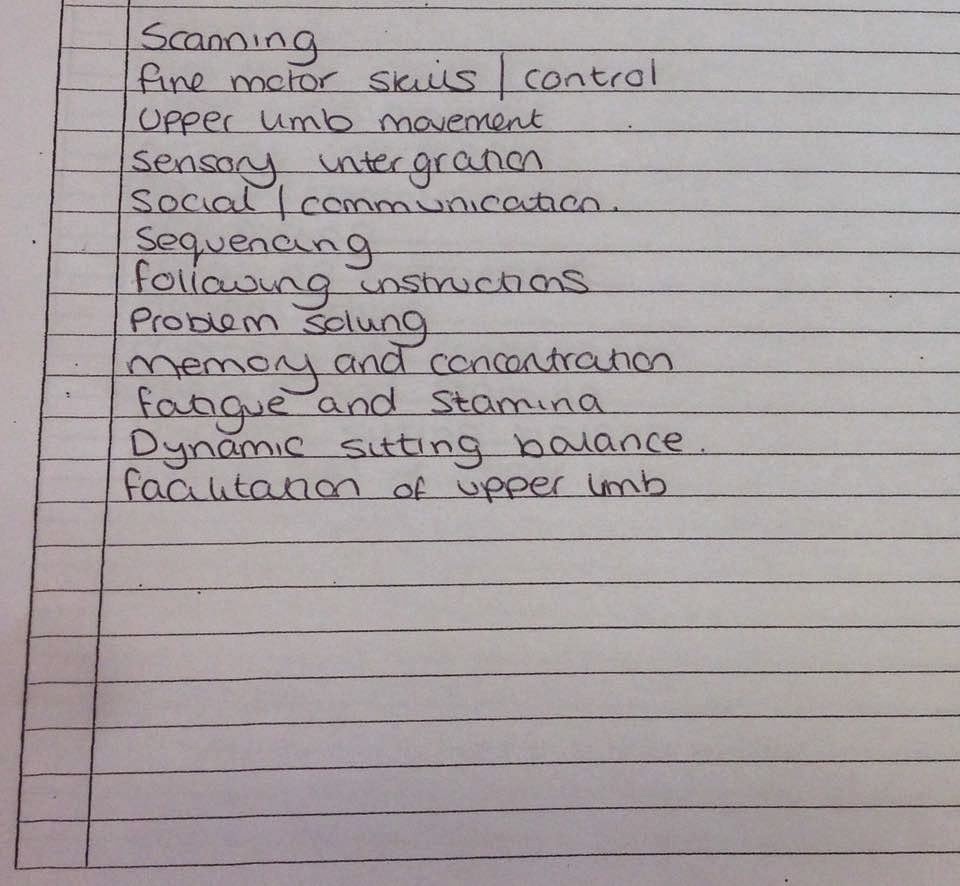
A check list I created highlighting the aims and focus of therapy my group session would cover

I created this form myself as a risk assessment checklist of stroke patients complex individual needs addressed within a group therapy session.


So, I needed to think of some ideas of activities that would address these complex needs! I came across this idea on Pinterest... 'The Tree of Many Colours' and this really inspired me to incorporate this idea into my group. As you may have read in my previous posts, I came up with some weaving project ideas which could then be easily incorporated into the tree based piece of artwork.


...And I adapted it to enable stroke patients to engage in the activity using just one hand (as they usually present with one sided weakness in an upper limb) by using a laminated sheet of paper, some velcro (I love velcro) and a bit of masking tape. What is it they say? Once an OT always an OT?

Why a tree?

I named my project The Recovery Tree. I thought the tree is an amazing symbol to represent stroke and the situations people are going through after stroke. A tree represents the condition. Each branch of the tree represents the carers and loved ones supporting the beautifully unique, patterned 'leaves' which of course represent the stroke survivor. The strong, atmospheric tree represents the condition, which has bought all of these people and connected them together. It also highlights the healing power of 'branching out' and sharing experiences with others that have been affected. A tree with it's ability to re-grow and blossom represents stroke recovery and neuroplasticity of the brain.


The activities.

Being within a group setting and collaborating with others to create a piece of art work addresses the aims and goals within the patients short term therapy programmes. To complete the activities I had planned the patients would need to use; complex concentration skills, skills in following and of course remembering instructions, communicating with others, use a range of sensory mixed media materials to promote sensory recovery, visual scanning as well as involving their affected upper limb, fine motor control, managing fatigue levels and their sitting tolerance... and of course they have to be motivated....Wow.

The fun part of planning.


I love feeling inspired and creating! This placement has enabled me to do both of these things and I am very grateful for the experiences and amazing people I have met along the way. Here I am preparing the tree.


The group.

I gained verbal consent for participation in my group therapy session and 6 clients chose to join in. Each client with their own individual needs in their road to stroke recovery. With the assistance of an OT, a therapy assistant and a student physio, I prepared the room for my session. The clients were seated in a group together instead of the usual groups of separate tables. I presented the clients with a wide variety of art materials and placed them onto the table. I also placed down sheets of paper with different sized circle shapes drawn on to them (Great for visual scanning) and placed down the weaving CD activities. I explained the project and visuals were offered to the hard of hearing clients. I showed them the tree and asked if they could help me decorate it with bright colours.


Some clients chose to weave while others chose to colour in, collage or paint. The group fell silent with the high level of concentration! Weaving with wool sparked some lovely conversations about knitting hobbies amongst individuals. Whereas the activity also promoted conversations about doing new things and new hobbies to aid in recovery. Clients seemed to really enjoy choosing their favourite colours and patterns to decorate their small individual pieces. Some clients required some motivation and guidance during the activity and this worked well.

The clients required some re-assurance as I do find when you mention engaging with art to most people in general they have an anxious reaction claiming "Oh no I can't draw" or "I don't have a creative bone in my body." Well I believe everyone has a creative side hidden within them somewhere... and when you see the finished product I'm sure you will agree. The clients worked so hard and some concentrated for up to 2 hours! Some clients are having to re-train their brain to use their previously non-dominant hand and turn it into their now dominant hand! That is such a difficult thing to do and this activity was really good practice for fine motor control regarding this.

The final product.

After working so hard, the clients returned to their rooms for a well deserved rest and cup of tea after a marathon 2 hour therapy session! The clients reported that they had enjoyed their morning and engaging in something a bit different :) Here's what you've all been waiting for...


The Recovery Tree

A collaborative therapy project by Victoria Jones and participating stroke survivors

Acrylic and mixed media on canvas. 80cm X 80cm.


References

Beesley K, White J. H, Alston M. K, Sweetapple A. L & Pollack M. (2011) 'Art after stroke: the qualitative experience of community dwelling stroke survivors in a group art programme', Disability and rehabilitation, 23-24 pp. 2346-2355.

Health + Culture (2015) Art and Stroke Recovery Available at: http://www.healthandculture.org.uk/programmes-artists/programmes/art-and-stroke-recovery/. Accessed: 5th May 2015.

Morris J. H, Kelly C, Toma M, Kroll T, Joice S, Mead G, Donnan P, Williams B (2014) Feasibility study of the effects of art as a creative engagement intervention during stroke rehabilitation on improvement of psychosocial outcomes: study protocol for a single blind randomised control trial: the ACES study. Open access journal available at: http://www.trialsjournal.com/content/pdf/1745-6215-15-380.pdf. Accessed: 5th May 2015.