Friday, 29 April 2016

Taking one step forward and two steps back.

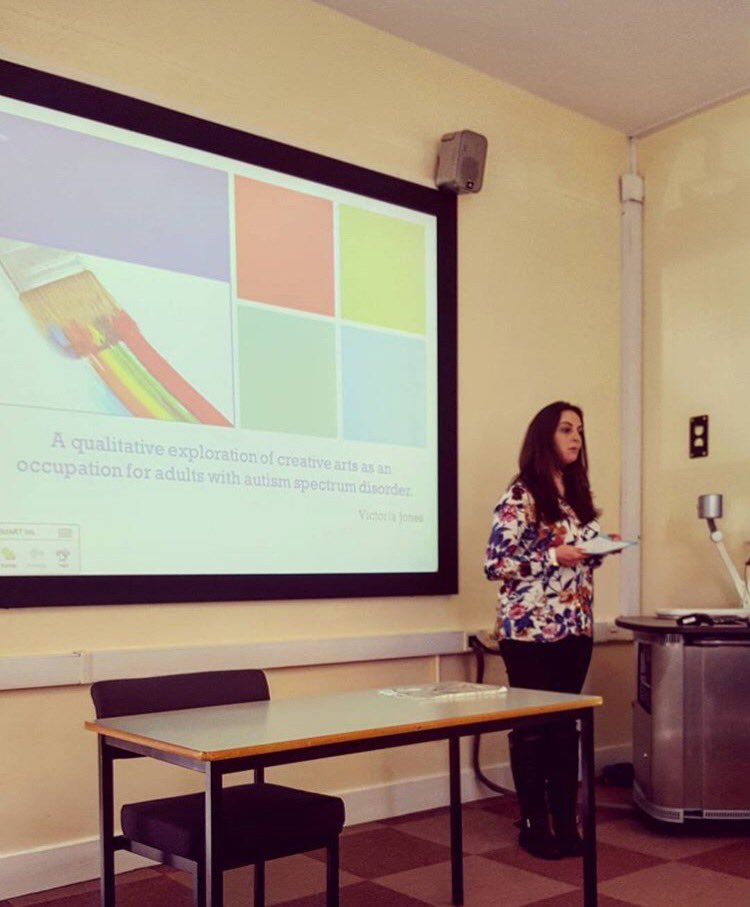
Presenting at the research conference really did make me feel positive and gave me the encouragement to 'keep calm and carry on' working on my dissertation over the past few weeks and this positivity really shines through in my last post!

However, it is proving to be a very long and hard process and I have begun to feel a little saturated with it this week. At times I feel I am taking one step forwards and feeling positive that something has gone well and then the realisation that this may not be at the best standard it could be... back to the drawing board and two steps back again.

It is of huge importance to me that I represent service users voices within my research, and on reflection I have realised that this poses to be more difficult than I had originally thought. Due to certain characteristics of autism spectrum disorder, individuals experience difficulties exploring answers in depth and it is these answers that are most important and that I am struggling to represent within my dissertation. I tried to represent their responses in statistical format (Much to my dismay!) However, as usual, I am no good with numbers and this did not work out for me and also didn't really match up with the qualitative nature of my study.

It is back to the drawing board once again - I am determined to get these service users voices heard and represented!

2 weeks until hand in date and counting.

Sunday, 10 April 2016

Personal reflections of presenting at MScOT student conference

So this week I presented my research at the MScOT student conference! To be honest I hadn't really thought about it before-hand but reflecting back upon participating in the conference although small, it was actually a really big achievement that I should be very proud of. The day at the conference was very inspiring and it was great to hear from the other students in my cohort and how they are getting on in their research journeys - they have all done some incredible work and it was fantastic to see their vision, enthusiasm and passion! I am so proud to be a part of that.

I began my course with no prior experience of research and my experience lay in a non-academic subject. I stood up in front of a group of peers and a professor of research this week and discussed the little project I have been undergoing and actually realising that I have put a lot of effort into it and it's not as little as I had thought...

The conference began with a very passionate and inspiring key note from Anna Clampin which really got me thinking and reflecting on my own experiences! I would like to share some of the key messages that inspired me with you through examples from my Twitter account:


I just thought this was the most amazing quote with so much truth within it! Anna got us thinking about the heart, mind and soul of OT and how we all have our own stories that led us into the profession: For me it was an interest in the use of creative activities in therapy and the experience gained through working with adults with autism, promoting independence in daily living skills and later on in my career, facilitating creative arts groups. Although we each have our own little stories and we each strive to provide independence and the best practice possible to our service users - are we being too casual about our practice? The OT profession truly is unique and extremely valuable. We must remember that although our interventions may appear simple to an on-looker, they are extremely complex, well researched, occupation focused and wonderfully compassionate. What we do is powerful in it's simplicity and as a future OT I need to remember that it's not all about your average person centred practice and just getting your head down and practicing the way it has always been done within a service. It's about being proud of what I do and it's about remembering my professional head and being able to justify what I do with a strong evidence base and with confidence - Whilst of course always keeping my big and compassionate heart.


By introducing evidence based interventions and research within a service it may provide a new way of thinking or improve service provision. This got me thinking about some of my practice placement experiences where I have designed and implemented an intervention (Usually something arty of course!). The OT's within the team have usually really enjoyed my planning stages of the process as I have often shown them pieces of research and evidence to justify my intervention that they have not come across themselves that they could use within their service. As a future practitioner I hope to continue using current research and evidence to justify and defend my practice from a local level to even promoting services at a national level.


Reflecting back, I have come to realise that my dissertation is not just a representation of my research journey, but it is a representation of my occupational therapy journey, and my little story that led me here in the first place! I have combined my passions and interests of art and autism (yes, I know this is bias) and used them to create my research project which is a reflection on just how much I have really learned on my journey in becoming an OT.


Part of my presentation included the rational for my study which included some pretty hard hitting statistics which have been released recently which highlight a severe lack of knowledge of individuals with autism throughout adulthood. By presenting this information it really opened my eyes to the fact that I was possibly thinking too casually about my 'lovely, little, creative research project' that I thought nothing would come of. Actually these statistics highlight that my piece of research (although small) is actually very relevant in the current autism research 'climate.' Although small, my big heart and compassion has gone into the design and implementation of this project and I designed my data collection meticulously in a person centred way to ensure that service users had their own say on the subject as this was very important to me within my research. 


At this stage I still have some data to analyse but I do have some preliminary themes (as above). These themes may pose many potential and positive outcomes for some adult individuals with autism. Anna has helped me realise that I have had a 'proper' OT focus throughout the process of my project so far and I have displayed my big heart and my compassion for what I do. Before I presented my research I felt as if my project was just 'something and nothing' however it is now time for me to find my professional head that my tutors and educators have been teaching and nurturing. It is time for me to wear that proudly and realise that.... WOW, I have produced a piece of work that is totally relevant and could influence services?! Could this be cost effective and holistic and prevent pharmacological approaches? This could promote my profession! 


I did that!

I must admit the OT in me is wanting to crawl back into the woodwork and hide away a little bit... and I think that comes naturally to us. But presenting here made me realise that we really can't hide away! 


Thank you to Anna for making me realise this and for my colleague who posted this take home reminder!


Get over it Vicky.


References 

Clampin, A. (2016) 'Research and Evidence – tools for a Profession’s development?' Keynote presented at MScOT Student Conference, University of Cumbria. 6th April.

Hirvikoski, T. Mittendorfer-Rutz, E. Boman, M. Larsson, H. Litchenstein, P. Bolte, S. (2015) ‘Premature Mortality in Autism Spectrum Disorder’, The British Journal of Psychiatry, 207(5), pp. 1-7.

Saturday, 2 April 2016

Hello

It has been that long since my last post that I almost don't know where to start! Here goes...

Dissertation

My dissertation project is now well under way and the deadline is in just over a months time! So scary. I remember my first few weeks on the course feeling totally bewildered and confused about research and even contemplating whether I had made the right decision to do the course. I started the course not knowing what the words qualitative and quantitative even meant. I can't believe that me... yep little old me is underway with a masters research project! I never thought i'd see the day.

Anyway, enough of the emotional, nostalgic reflection 

My research project is entitled "A qualitative exploration of creative arts as an occupation for adults with autism spectrum disorder" and as I say, I am well underway on my qualitative explorative journey! I recruited participants to engage in semi structured interviews and questionnaires and I am using a thematic analysis process to analyse my findings. I am presenting my results so far at the University of Cumbria's MScOT student conference next week!

My dissertation has kinda taken over my life a little at the moment, but that was to be expected! It is incredibly difficult to balance dissertation work with other university modules at the moment, but I am getting there hopefully! It really does help that I am passionate and really interested in my dissertation topic - that definitely keeps me going!

University modules

I have just finished what has been my favourite module of the course so far where we were working in groups to practically design and implement an OT intervention with a chosen client group. My group chose to design an intervention based upon the theory of reminiscence and was targeted at the client group of over 65 within retirement properties. A lot of hard work went in throughout the whole process of designing and implementing the intervention, and that is never an easy process in a group full off passionate individuals, each with their own opinions, values and beliefs! My group also had to account for unforeseen circumstances such as the intervention being cancelled last minute due to norovirus - meaning we had to find a change of venue as quick as possible. Although stressful at times the experience was entirely positive and the module has allowed me to learn and gain valuable experience of a client group I have never worked with and also gained experience I can transfer into future practice regarding reminiscence techniques and OT practice with older adults.  I know I often look at things through rose tinted glasses but I can honestly say that I enjoyed the intervention so much, it was a beautiful afternoon and we gained some fantastic feedback highlighting that there is indeed an ever-growing need for OT intervention and support with this particular client group.

We have also started our last university module which involves a viva in August which is our last exam! Although it feels ages away at the moment, the end is growing closer.

Placement

Our final 10 week placement is also not too far away as we start at the end of May. I have been on a visit to my placement to meet my educator and find out some information in preparation! I am really looking forward to this placement as it is in the area of learning disabilities and I can't wait to find out  more about the role and practice of OT in this area, I feel excited about the new opportunities this will  give me and also the opportunity to use transferable skills I already have. Including information I learned regarding sensory integration techniques for my viva last year... perhaps that viva wasn't so disastrous after all... 

So that's life at the moment! It's hectic, intense and the hardest I've ever worked. I did have a little break from uni work this week though for my birthday which was bliss!

Back to it now though as unfortunately, dissertations don't write themselves! 
 

Tuesday, 19 January 2016

Update!

The lack of posting in my blog really reflects how busy and intense 2nd year of the MSc really is! I am happy to say that I did pass my PP3 placement back in December and I did manage to  meet my placement objectives. I gained so much valuable experiences and it really opened my eyes as my first mental health placement of how transferable my work experience and my art skills are to this area of practice - I can definitely see mental health being an option for my future as an OT. For my PP3 I did separate weekly reflections to add to my CPD file to present at upcoming interviews. It feels so scary that I will be applying for jobs in just a few months time! 

Life back at university has made me a very busy bee during January! We are currently working on our new module where we choose a client group and create an intervention based on their individual needs and interests which we will be facilitating in small groups of students out in the community! This module concludes with a group presentation and an individual reflection. I am really enjoying the module so far, I love being creative and engaging in practical "doing" activities! That is very OT after all! 

I am also busy working on my dissertation project and my data collection of interviews and questionnaires starts this week! Feeling very nervous but excited about this. Becoming an OT really doesn't feel that far away now... 

Monday, 23 November 2015

PP3 weeks 1 and 2

Community Mental Health.


My first couple of weeks with the community mental health team has been spent mostly by me getting to grips with the complex range of conditions, environments and even the many different roles within the team. Although the format of the team is similar to the community teams I've spent previous placements with, there are a lot more professionals and roles for example; OT's, support workers, CBT therapists, DBT therapists, social workers, nurses, clinical psychologist and pharmacist. It is an excellent opportunity for me to see the many different professions and how they work together to provide the service. I have seen this through attending various MDT meetings and clinical discussion meetings, which have given me a really good insight and enabled me to voice my views and opinions on service users that I have met on community visits.

So far I have spent time on visits with the OT's and a couple of the support workers in the team. This has enabled me to see a variety of service users with varying mental health conditions. Within the team here the OT's practice by using the framework of the CMOP-E and by using this I have been able to go out with support workers and reflect afterwards, using this model to assist me in having a holistic occupation focus. Although the OT's use the COPM - I am yet so see this or assist in administering this assessment tool as a lot of the service users have had OT involvement for a long period of time and are currently not in need of this assessment. Although I have seen very little standardised assessment tools, I have seen the importance of observation skills within community visits.

Community mental health OT differs quite a lot from my experience in physical community settings. This is because recovery in mental health is a very different process. It is discussed by Lloyd, Wong & Petchkovsky (2007) as a subjective and individualised process:

"Unlike the biomedical definition of recovery, it is not a predictable and medically mediated process, but the emergence of a new identity as a product of self-discovery." (p. 207).

Due to this, I have observed that the OT process involving individuals with mental health conditions can be a very long process and often very cyclical, remaining on the goal setting, intervention/assessment and evaluation stages, changing as a person progresses or adapting for varying needs relating to their condition. OT in mental health appears to be a lengthy process with service users facing many set-backs and barriers to their OT interventions. Some of which include, drug addictions, low motivation, low mood and impaired sense of safety-health and well being etc.

It is very interesting to have seen both sides of community OT within my placement experiences and to be able to contrast and compare the two. Due to the nature of this setting, I feel it is going to be more difficult to perform at the higher level expected for this placement and I have found this difficult during the past two weeks as I have needed this time to 'find my feet' and get to grips with the new conditions I am experiencing and how the team works. 

In-patient Unit


During placement I will be spending one day a week on the in-patient unit and my first day on the inpatient ward was a totally new experience for me. At first I did feel a little apprehensive on the ward as I observed the impact of severe mental health conditions upon the occupational identity, roles, habits, motivation and routines of individuals. I observed the OT using MOHO based screening tools to interview individuals to assess their occupational profile, using narrative clinical reasoning skills to build up an occupational picture of how that person has been in the past, what they are functioning like currently and what they want to do in their future. A shock for me was the impact of their current mental state as the individual being interviewed currently felt that they had no role or purpose in their life, no routine and no hobbies/interests. The part of the OT screening that I really liked was a questionnaire about a persons hobbies and interests which asked a person what hobbies/activities they have engaged in, in the past or had an interest in, and if there are any activities they would like to get back into in their future to assist their recovery process – or even try out some new activities. This for me felt very occupation focused and was assisted with the structure and occupation focus from the MOHO framework.

I also observed arts & craft groups, baking groups and pamper groups taking place for individuals from the ward to take part in. Although this was occupation focused and person centred I did observe that the support workers within the team had more involvement in engaging in these groups reflecting possible generic roles.

I spent some time on the intensive care unit too and engaged in a mindful arts and crafts session. The ward was a very relaxed, friendly atmosphere and the service users appeared to be enjoying the activities offered.


As part of my placement objectives I am currently researching and planning into an art therapy group that I can implement myself on the inpatient unit. This is a personal passion of mine and a huge interest within OT practice so I am very excited by this opportunity.

Acute Therapy Services


The ATS team was another new experience for me. ATS supports individuals for 5 days a week providing holistic, structured activities to aid recovery and to prevent hospital admission. It’s service is unique and the only service of its kind in the country. Within the team is an OT, mental health nurse and support workers.

On arrival I introduced myself to the service users and the atmosphere automatically felt very laid back and relaxed. The service is focused on letting the SU be responsible for their own care and they are not treated as secure patients, they have access to everything and it is their choice should they choose to engage in the structured activities provided.

For the first time on a placement I did not feel like a 'professional' and didn’t feel that client – professional divide within any of the sessions or the environment. Everyone was treated as equal and I felt this made a huge difference to the service users and indeed to the professionals.

The daily activities began with breakfast club, a mindfulness breathing exercise, followed by an art session and then helping to prepare a buffet lunch. The afternoon offered holistic therapies including, massage and the group engaged in more laid back leisure activities including playing card games, board games and engaging in conversation – some laughter therapy! Others chose to sit in quieter areas to relax and un-wind. All of the activities offered provided individuals to socially interact and talk/share about their own experiences and interests in a non-judgemental environment.

I really enjoyed my experience with the ATS team and I will be spending more of my time there during placement.

Placement Objectives


To help me achieve the objectives for my placement, I have set out the following objectives in my learning contract:

  • Case study
  • Use some assessment tools and models in practice
  • Take an OT referral during MDT meeting
  • Plan and implement an art group on the inpatient unit
  • Take the lead on an intervention with 1 service user
  • Develop an understanding of a range of MH conditions


To begin meeting some of my objectives I have created a visual mind map to illustrate the role of the OT within the community mental health team. This includes:

  • Conditions
  • Symptoms
  • Affect on occupational performance
  • MDT & Interagency working
  • Models
  • Legislation
  • OT Process
  • Interventions
  • Assessment tools
This has helped me look at the service as a whole and look at the OT role within the team to gain a wider understanding as I am observing on my placement.

I will blog over the next few weeks about my progress on placement :)

References:

Lloyd, C. Wong, S.R. Petchovsky, L. (2007) 'Art and recovery in mental health: a qualitative investigation. British Journal of Occupational Therapy, 70(5), pp.207-214.

Sunday, 15 November 2015

Losing my pets... an occupational therapy perspective.

As an occupational therapy student I now have this constant awareness of occupation all around me and around each person that I encounter. I have an in-built understanding and awareness of environment-person-occupation and of which occupations constitute as self-care, leisure or productivity or even what activities are meaningful enough to a person to be considered as an occupation in the first place.

One of my most meaningful occupations in my life was being an owner to my two cats Suki and Amber. Unfortunately I have lost both of my cats this year. Suki passed away in May and Amber more recently in November. Occupational therapy has given me an awareness and understanding of why my cats meant so much to me, and why it has caused me much distress to have lost them.

Duncan (2011) discusses that occupational therapy is concerned with the key elements of both occupational performance and occupational identity. This can be explored as how a person identifies themselves, their roles and their relationships within their physical and social environment. From this I have realised that a big part of my occupational role was being a pet owner and this was also a huge part of my occupational identity. This dawned on me recently when Amber had passed away and the thoughts of meeting new people on placement...

"Hi my name is Vicky, I have a little cat called Amber, and she only has one eye as she was ran over... look how cute she is!" Oh...

Being a pet owner can be conceptualised as an occupation as it refers to groups of activities and tasks of daily life (Allen 2000). Allen (2000) & McNicholas et al (2005) explore that pet ownership can provide structure to daily routines and can contribute to the areas of self-care, leisure and productivity. Here is my illustrated version:


Routine, self-care, leisure and productivity.


My day would generally start promptly at 6:00am by being 'dive bombed' off the window ledge by this one, closely followed by a lot of purring down the ears, a lick to the face and if I was being really lazy, then a bite to my toes. I would then get up to feed her and get ready for work or uni. This is Amber by the way.


Amber would make sure I did my hair and make-up just right... and would make it as difficult as possible to undertake my self-care activities, especially by stealing my towel...and even my shoes!


Suki loved to get involved with my occupations of leisure and productivity, here she is 'helping' me to knit and wrapping presents.


They both loved to get involved in my uni work and made excellent study companions. I think Suki however, became quite jealous of the laptop taking up space on my lap. 

From this illustration it could be questioned if my occupation was a pet owner who looked after my cats or was I the pet and my cats were the ones looking after me... I think the latter somehow! 

You can see that within my daily routine as a 'pet' my cats were a huge part of my everyday life, and were involved in the majority of my daily occupations at home. I have referred to them above as companions and I do think of them as family members and this is also reflected by McNicholas et al (2005) that over 90% of pet owners within the study regarded their pet as a valued family member. It is also discussed further that 'companionship' may have an importance in fostering positive mental health on a daily basis. 

I can personally relate to this notion that my cats definitely had a positive impact upon my mental health and their little characters genuinely made me happy, laugh, smile and gave me a purpose. I would look forward to coming home after a long day to sit balancing both purring cats on my lap with a cup of tea to un-wind. To look after my cats by feeding them good food, spoiling them with treats, toys, grooming you name it was such a rewarding occupation for me to engage in as they gave so much back in terms of companionship and love. Nicholas et al (2005) discuss that people value the relationship and the contribution their pet makes to their quality of life, reflecting my opinion completely. Looking after their health was a huge part of this too as Amber had a terrible accident in 2013 resulting in losing her eye and fracturing her jaw. It took months of surgeries and tube feeding to nurse her back to health. This therefore did cause me some stress, lack of appetite & sleep and did have a negative impact upon my occupational performance at that time.


But of course I wouldn't have had it any other way! This is an important point though that as well as enhancing quality of life, pet ownership can be stressful at times and the death of a pet can cause extreme distress for owners (Allen 2000, McNicholas et al 2005). Although discussed by Nicholas et al (2005) that pets may be of particular value to older people and patients recovering from major illnesses, there is therefore a risk of a person becoming so attached and reliant on their pet for their quality of life, routines and social interaction that the loss of a pet could cause a reversed affect and the person could become stressed, anxious or socially isolated, having a negative impact upon their occupational performance and general health. From this it is evident just how powerful pet ownership is as an occupation and an experience that I have encountered twice in one year.

To conclude my discussion, it is important as occupational therapists to recognise pet ownership on the impact of occupational roles, routines and occupational identity as it could have a significant meaning within the life of an individual. Pet related occupational therapy interventions could therefore be effective in promoting independence and enabling occupation (McNicholas 2005). 

I hope that this blog post has given you an insight into my occupational identity and role as a cat owner, I really wanted to celebrate their little lives and how they made each part of every day special and unique for me and in turn definitely enhancing my occupational purr-formance. 


References:

Allen, J. M. (2000) 'The Experience of Pet Ownership as a Meaningful Occupation', Canadian Journal of Occupational Therapy, 67(4), pp. 271-278.

Duncan, A. S. (2011) Foundations for Practice in Occupational Therapy. 5th edn. Edinburgh: Churchill livingstone Elsevier.    

McNicholas, J. Gilbey, A. Rennie, A. Ahmedzal, S. Dono, J. Ormerod, E. (2005) 'Pet Ownership and Human Health: A Brief Review of Evidence and Issues', British Medical Journal, 331(7527), pp. 1252-1254.

In at the deep end...

The first term of second year has proven to be very fast paced and very intense and I have appeared to have neglected my blog over the past few weeks and not really given myself time to reflect! Note to self... in reflection I need to give myself more time to reflect! However it can be a challenge with a very busy timetable.

So... what have I been up to!?

During the 5 weeks of term I have been attending classes for my Applied OT (2) module and learning about many different specialist areas of OT. Along side this I was learning and researching another specialist area of OT in preparation for an assessed 30 minute viva examination. Alongside this I have been working on my dissertation ethics documentation (which have now been approved!), and I have also been preparing for placement. I have just finished my first week of placement but I will be writing separate posts about this.

So the past few weeks I have spent time mostly stressing out about the Viva... I think this is because I had never done a viva before and was unsure of what it looked like, and the expectations of masters level within a speaking examination. Here are strategies I used to prepare:

To begin with I chose a topic area that I was interested in but didn't know a lot about. I chose paediatric OT using a sensory integration approach. Sensory integration is something that I have an interest in and I chose paediatrics as there was more literature available and to make the most of learning about a new area that I have no experience of.

I started by slowly reading... and I did a lot of reading! Just to gain a broad understanding and a foundation to build further understanding on the topic area. On reflection I probably did read too broadly as I ended up with 40 pages of notes scattered everywhere in no particular order which made the situation a lot more stressful (I wouldn't advise doing it this way!). I also ended up with lots of tabs open on my laptop and was not very organised in keeping on top of my referencing as I went along. At that stage I did feel very stressed out...

I decided then that the best way for me to collate my information and condense it altogether would be to create a visual mind map basing it around the structure of example questions that had been provided to us.


This did end up being quite a giant mind map even though I did condense a lot of the information I had gathered! Our formative assessment for this module was to present an overview of our specialist area to a group of 1st & 2nd years and a tutor. This actually proved to be quite helpful for me as it made me aware that I had gathered a lot of un-neccesary information that was quite descriptive. It also helped me to gain ideas of areas I could critique and go further into depth with.

After the formative assessment I made a plan and did yet more reading and added more critique to my information. I then condensed this further and typed it into a script. Now I know we were not to learn our information in a script but in order for me to learn and retain information, I have to put the information into a structure or an order (I spent a lot of time being baffled by this!) 

A good tip which I would personally advise is to try and practice your viva with someone, however I know for some people this is not possible. I practiced my viva with my partner and told him to deliberately switch the order of the questions as he was asking them so I would not be reading from a script of information and so that it would flow more freely. This was really difficult at first as it did highlight weaknesses (like responding in scripted answers) but it gave me really good practice of what to expect in the viva and it helped be be more conversational with my answers.

How did the viva go??

Unfortunately my little pussy cat passed away the night before the viva (if you know me, you'll know just how much I loved my cats). I traveled to uni on my 3 hour long commute on just 2 hours sleep and feeling very distressed.

But, I did manage to get through the viva and even though I was not feeling my best, the experience wasn't as bad as I thought it may be! The environment was actually very relaxed & friendly and after a few minutes I forgot I was being filmed or that I was in an exam at all at times! I felt relaxed into the conversation (This may also be a bad thing) but I won't know how i have done until we get our results in another couple of weeks so I have my fingers crossed!

So all in all it has been quite an intense few weeks to say the least. I think because of the volume of work required in such a short space of time. On reflection I needed to be far more organised with my preparation methods! This is a good outcome though as it will assist me in better preparation for my 45 minute viva next year!

I will post soon about my placement and dissertation I promise! :)